Built for Reality, Not Demos

Most analytics tools assume your BAS data is accurate and your network is healthy. A•IQ verifies both. We operate across four real layers of building automation:

Physical Behavior
Vibration, motors, sensors
Control Logic How your programs actually execute
Alarm Behavior How operators experience events in practice
Network Transport How data moves across BACnet/IP and MS/TP

This means A•IQ doesn’t just tell you that a problem exists, it tells you why it exists and where to fix it.

Alarm Intelligence That Matches How Operators Actually Work

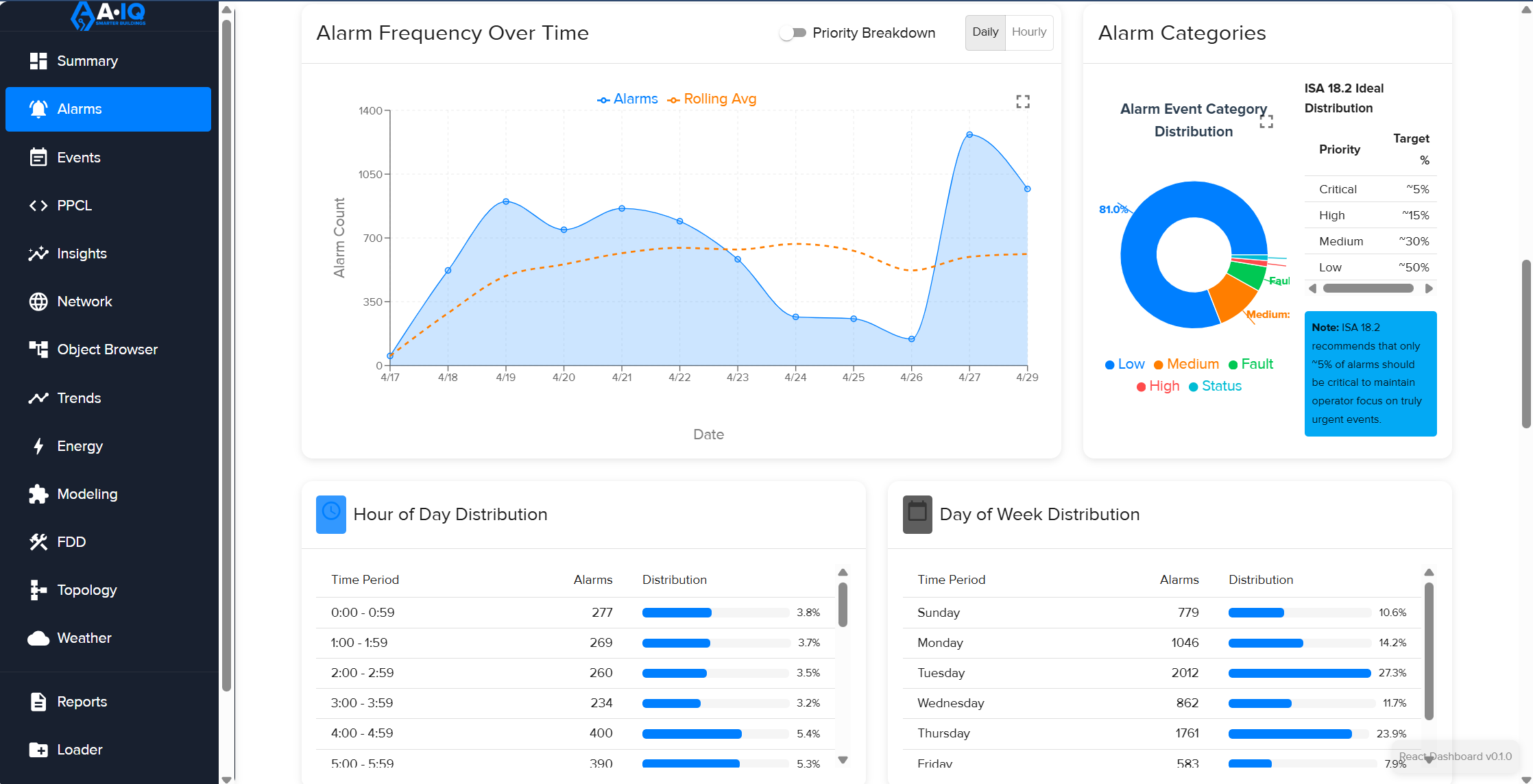
A healthy system isn’t silent, but it also shouldn’t overwhelm your team. A•IQ studies how alarms behave over time, not just how many exist today.

  • What A•IQ Actually Does

    Identifies chattering alarms, stale points, and bad actors
    Tracks alarm lifecycles from activation through resolution
    Measures operator response load, not just alarm counts
    Weighs alarms by true impact, not just priority text

  • Standards-Anchored, Not Theory-Based

    Alarm behavior is profiled against ISA-18.2 and EEMUA-191 principles to highlight:
    - Over-alarming
    - Priority misuse
    - Nuisance conditions
    - Hidden shutdown risks

    This isn’t just reporting, it’s alarm system hygiene with operational consequence.

Your Control Programs Are Assets. Treat Them That Way.

Most teams don't know their PPCL code has problems until something breaks. A•IQ parses every line, flags every issue, and scores your logic health before operators ever see a symptom.
  • Unresolved flags — code paths that never execute properly
    Invalid points — references to objects that don't exist or respond with "?"
    Disabled lines — logic someone turned off and forgot about
    Long lines — code exceeding 198 characters that may truncate silently
    Syntax anomalies — orphaned GOTOs, missing returns, timer conflicts

Code quality isn't about style. It's about whether your building does what you think it does.

Patterns Your Team Can't See.
Predictions They Can Act On.

A•IQ applies machine learning to your alarm history, not generic models, but training specific to your site's behavior.
The result: insights that actually mean something.

Trend Detection

Identifies increasing or decreasing patterns with statistical confidence. Know when "normal" is drifting before it becomes abnormal.

Anomaly Flagging

Isolation forest algorithms trained on your baseline. Spots unusual activity even when individual values look fine.

Peak Hour Mapping

Understands when your building is busiest and when alarm loads don't match operational patterns.

True Priority Weighting

Moves beyond text labels. Weighs alarms by actual operational consequence, not just what someone typed in a config file.

Alarm Clustering

Groups related alarms automatically. See which events travel together so you can address root causes, not symptoms.

Load Forecasting

Predicts alarm volumes by hour, day, and season. Staff and prioritize based on what's coming, not what already happened.

Time-Based Analysis

Your Building Has a Rhythm. A•IQ Learns It.

Alarm behavior changes by hour, day, season, and shift. A•IQ decomposes these patterns to distinguish expected variation from genuine anomalies.

Extract

Cyclic time encoding captures hourly, daily, weekly, and seasonal patterns from your data.

Decompose

Statistical decomposition separates trend, seasonality, and residual noise.

Classify

Anomalies are flagged relative to what's normal for that specific time context.

Alert

Different rules for 2 PM Tuesday vs 2 AM Sunday. Because your building behaves differently too.

Different rules for 2 PM Tuesday vs 2 AM Sunday. Because your building behaves differently too.

One Alarm Is a Symptom.
The Pattern Is the Problem.

Equipment doesn't fail in isolation. A•IQ maps relationships between events across your entire system, finding cascade failures, identifying root causes, and revealing which alarms are consequences of upstream issues.

Temporal Correlation - Events that consistently occur within the same time window
Cascade detection - Sequences where one failure triggers a chain reaction
Equipment relationship graphs - Visual maps of how your systems influence each other
Sequence prediction - Knowing what's likely to fail next based on what just happened.
  • Stop treating every alarm like an independent event. Start seeing the system.

weather

Weather Affects Everything.
Now You Can Prove It.

A•IQ integrates real-time weather data and correlates it with your alarm patterns. Temperature swings, humidity changes, storm fronts see exactly how external conditions impact internal operations.
  • Temperature Correlation - Which alarms spike during extreme heat or cold
  • Humidity Tracking - Moisture-sensitive equipment flagged before failures occur
  • Seasonal Forecasting - Predict maintenance loads based on weather outlook
  • Storm Impact Analysis - Pressure and wind correlations with system behavior
Your HVAC doesn't care about your maintenance schedule. It cares about the weather.

HUMAN FACTORS

Operators Aren't Machines. Design for Humans.

Alarm floods don't just cause missed events. They cause fatigue, burnout, and turnover. A•IQ measures operator load the way cognitive science says it should be measured: by attention demand, not just count.
  • Response time tracking - How long operators take to acknowledge, by priority and time of day
  • Attention demand scoring - Weighted by alarm complexity, not just volume
  • Shift-based analysis - Different baselines for day, evening, and overnight crews
  • Fatigue indicators -Patterns that suggest overload before incidents occur

Your alarm count might be "acceptable." Your operators might still be drowning

From Data to Action

Insights Are Useless Without Next Steps

Every A•IQ analysis ends with specific, prioritized recommendations. Not generic advice. Actions tied to your data, your patterns, your equipment.

Trend Insight

AHU-3 discharge temp alarms increased 47% over 30 days. Recommend inspecting damper actuator and verifying sensor calibration.

Anomlay Insight

Unusual alarm cluster detected in Building C, Floor 2 between 0200-0400. No scheduled maintenance. Investigate potential unauthorized access or equipment malfunction.

Correlation Insight

VAV-127 alarms precede AHU-2 high static pressure 83% of the time within 15 minutes. Consider treating as single root cause.

Pattern Insight

Monday morning alarm spikes are 3x higher than other days. Correlates with weekend setback recovery. Consider staged warmup sequence.

Weather Insight

Chiller alarms increase 340% when outdoor temp exceeds 95°F. Current capacity may be undersized for extreme conditions.

Recommendation

Top 3 actions for next 30 days: 1) Retune PID loop on FCU-44, 2) Replace failing sensor on AHU-1, 3) Investigate intermittent comm loss on Panel 7.

COMING SOON - FAULT DETECTION AND DIAGNOSIS

From Alarms to Answers. Automatically.

Alarms tell you something's wrong. FDD tells you what's wrong, why it's wrong, and what to do about it. A•IQ's fault detection layer applies rule-based and ML-driven diagnostics to identify specific equipment faults, not just symptoms.
  • Rule-based fault libraries Industry-standard fault signatures for AHUs, VAVs, chillers, boilers
  • ML-augmented detection Learns your equipment's specific failure modes over time
  • Severity scoring Prioritizes faults by energy waste, comfort impact, and equipment risk
  • Diagnostic narratives Plain-language explanations, not just fault codes
Stop sending techs to "investigate an alarm." Send them to fix a diagnosed problem.

coming soon - energy intelligence

You Can't Manage Energy You Can't See.

A•IQ is adding energy modeling and utility integration, connecting alarm behavior to actual consumption. See how equipment faults translate to dollars wasted.
Basic energy modeling Baseline consumption patterns by system, zone, and schedule
Fault-to-waste correlation Quantify the energy cost of detected faults
Green Button integration Pull real utility data directly into A•IQ for validation
Demand response readiness Understand which systems can flex and by how much
An alarm is an operational problem. An alarm costing $400/day in wasted energy is a business problem.

Every Sensor. Every System. One Truth.

Your BAS sees part of the picture. Your edge devices see another part. Your electrical monitoring sees another. Asset360 brings it all together, creating a unified view of every asset's health, performance, and position in the system.

Unified Data
Layer

One asset, all its sensors, one place
  • BAS Sensors - Temps, pressures, flows, positions, status
  • Vibration Monitoring - Bearing wear, imbalance, misalignment
  • Tribology - Oil analysis, contamination, degradation
  • MCSA (Motor Current Signature Analysis) - Electrical fault signatures
  • Power Monitoring - Voltage, current, power factor, harmonics
  • Edge Analytics - Any IoT or standalone sensor feeding the ecosystem

Performance
Baselines

Is an asset operating to spec or just operating
  • Efficiency vs. design - Is this chiller hitting its kW/ton?
  • Capacity vs. rated - Is the AHU delivering its CFM?
  • Response vs. expected - Is the valve actuating at the right speed?
  • Degradation curves - How is performance trending over months and years?

Full Topology
Mapping

Visualize the upstream power, downstream dependencies, parallel equipment relationships
  • Upstream — what feeds this asset? Which breaker, which panel, which transformer?
  • Downstream — what depends on this asset? Which zones, which processes?
  • Parallel relationships — which pump pairs with which chiller? How do they behave together vs. apart?
  • Cross-system impacts — electrical anomaly affecting mechanical performance affecting comfort affecting alarms

Cross-Source
Machine Learning

See and detect anomalies that only appear when you correlate everything
  • Multi-source anomaly detection — spot issues that only appear when you correlate BAS + vibration + electrical
  • Predictive degradation — trending across all sensor types to forecast failures
  • System-level pattern recognition — this combination of conditions across these five assets predicts this outcome
  • Root cause inference — when an alarm fires, trace the probable cause through the full topology automatically
Asset360 delivers building intelligence, the foundation for true predictive operations. One where you understand not just what's happening, but why, and what's coming next. One asset. Complete context. Full system awareness.