Your BAS generates more data than your team can process. Signal cuts through the noise, surfaces root causes, predicts failures, and eliminates alarm fatigue.
Three stages between raw BAS data and the prioritized action list your operators actually need.
01
Connect.
Bring in BAS, sensors, meters, weather, and utility data. Siemens, JCI, Honeywell, Niagara, or any mix. No rip and replace. Drop in next to what you already have.
02
Correlate.
Map relationships between assets, upstream and downstream. Understand cause and effect across systems, not just individual points. The chiller alarm and the AHU complaint are the same event.
03
Prioritize.
Not 10,000 alarms. The 12 that matter, ranked by operational impact. Recalculated continuously so every shift sees the same picture.
02 / Capabilities
What Signal sees.
Ten capabilities across three domains: BAS Intelligence, Edge Condition Monitoring, and Energy & Utilities. Each one solves a problem your team deals with today.
BAS Intelligence
Alarm Analytics
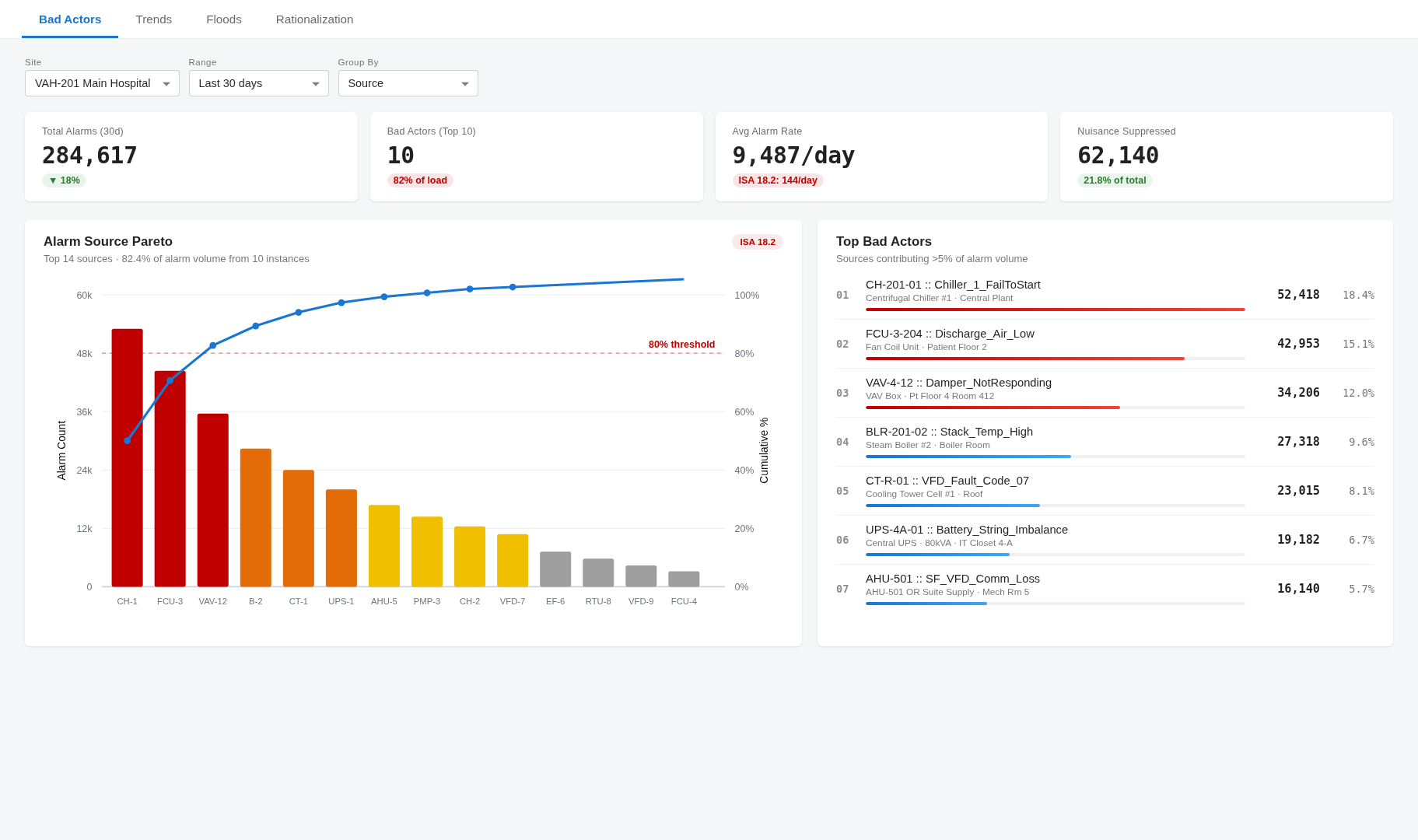
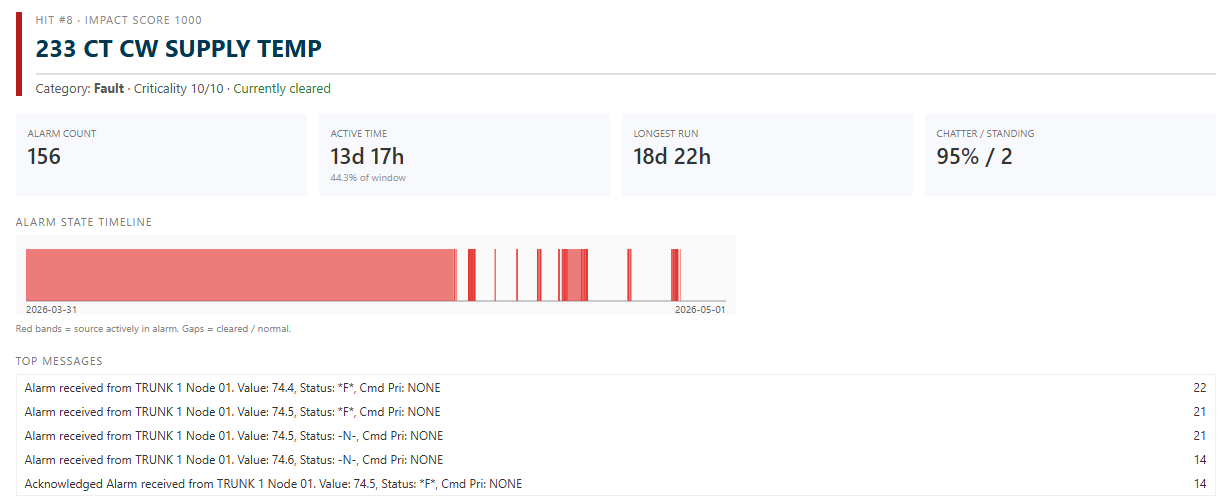
ISA 18.2 rationalization, automatic chatter elimination, and impact scoring that turns 10,000 daily alarms into a ranked priority list. Your operators stop drowning. They start fixing.
BAS Intelligence
Fault Detection.
Rule-based and ML diagnostics for HVAC. Catch failing valves, stuck dampers, and degraded coils before tenants call.
80%
noise eliminated · ISA 18.2 baseline
BAS Intelligence
PPCL Review.
Siemens control program analysis and code quality scoring. Your senior engineer is retiring. His BAS logic should not leave with him.
BAS Intelligence
Root Cause Analysis.
ML-driven event correlation and cascade detection. Stop chasing symptoms. Find the one upstream failure that triggered everything else.
Edge Condition Monitoring
Vibration.
Wireless bearing analysis and predictive maintenance. Know which motor will fail next month, not which one failed last night.
Edge Condition Monitoring
ESA.
Non-intrusive motor diagnostics via electrical signature analysis. No additional sensors on the shaft. Just clip onto the power feed.
Edge Condition Monitoring
Edge Sensor Fusion.
Combine vibration, temperature, current, and pressure. Cross-confirm faults. Reduce false positives to near zero.
Energy & Utilities
Energy Analytics.
Multi-source consumption intelligence across electric, gas, water, and steam. Spot waste before it shows up on next month's invoice.
Energy & Utilities
Green Button.
ESPI utility data parsing and bill validation. Import interval data directly. Catch billing errors automatically.
Energy & Utilities
Power Metering.
Circuit-level demand monitoring and cost allocation. Know exactly which tenant, floor, or system is driving your peak charges.
03 / Closed-Loop Operations
Signal identifies. Nexus responds.
When Signal flags a fault on AHU-3's supply fan, Nexus already knows the asset, its location, its maintenance history, and its parts inventory. One workflow from alarm to work order. No copy-paste between systems.
Most teams run building intelligence in one tool and asset management in another. Different vendors, different databases, different logins. A·IQ is one platform.
Engineers buy what they can read. Three excerpts from how Signal actually integrates: a Project Haystack tag, a Docker Compose service, and a BACnet point binding. Nothing here is marketing fiction.
On-premise by default. Cloud-deployable when required. Your facility data never leaves your network.
TLS everywhere, secrets in vault, row-level security on every query. Containerized and isolated so one service going down never takes the rest with it.
A·IQ is built by Arcis FM, a Service-Disabled Veteran-Owned Small Business (SDVOSB). Set-aside eligible for federal contracts. CAGE 14DG6 · UEI Z95MQL2KEYG3.
Operator and engineer questions on Signal building intelligence.
01
What is A·IQ Signal?
Signal is the building-intelligence half of the A·IQ platform. Alarm analytics with ISA 18.2 rationalization, automated fault detection & diagnostics, root cause analysis, energy analytics, and power-quality monitoring. On-premise. Integrates with any BAS.
02
How does Signal handle alarm fatigue?
Signal scores every alarm by chatter (frequency), nuisance (false-positive rate), and operational impact. Bad-actor scoring identifies the small set of alarm sources generating the majority of noise. ISA 18.2 compliant from day one.
03
Does Signal work with our existing BAS?
Yes. Signal integrates with Tridium Niagara, JCI Metasys, Siemens Desigo, Honeywell EBI, Distech Controls, Schneider EcoStruxure, and any BACnet, Modbus, or OPC UA-capable system. No rip-and-replace.
04
What does Signal's FDD detect?
Equipment faults (failed sensors, stuck dampers, simultaneous heating-and-cooling), sequence drift, manual overrides left active, schedule violations, energy anomalies, and degrading-equipment patterns weeks before alarms surface.
05
Is Signal a SaaS subscription?
No. Signal is a site-license deployment, on-premise, with unlimited users. No monthly per-user fees. Most CMMS competitors charge $50-150/user/month. Signal does not.
06
How is Signal deployed?
Three Docker Compose stacks: Infrastructure (Postgres + Redis + OpenBao + FusionAuth), Signal (intelligence services), and Nexus (CMMS, optional). On-premise Linux is the default. Air-gap capable for classified or sensitive sites.
Stop triaging. Start fixing.
Walk through a live Signal dashboard with your own building data. We will show you how 10,000 alarms become the 12 that matter, and how those 12 become work orders in Nexus before the next shift starts.